MASTER Your Goals
Forget SMART Goals. ADHD Brains Need Something Better.

I’ve been quiet on here for a few weeks. Not because I ran out of things to say - if you know me, you know that’s unlikely - but because I’ve been deep in something that needed time to cook. I’ve been running my first Group ADHD Coaching cohort, and in the middle of building the session on impulsivity, I hit on an idea that I couldn’t stop thinking about.
So instead of writing about it half-baked, I waited until I’d tested it with real people. Now I’m ready to share it.
If you’ve ever set a SMART goal and watched it quietly die within a week, you’re not alone. And you’re not lazy. The framework just wasn’t built for how your brain works.
SMART goals - Specific, Measurable, Achievable, Relevant, Time-bound - have been around since 1981. They work well for a lot of people. But they were designed for neurotypical brains, and they have three critical blind spots when it comes to ADHD.
First, they assume motivation will sustain itself. You set a goal, it’s relevant, so you’ll keep going. But ADHD brains aren’t driven by relevance. We’re driven by interest, novelty, urgency, and challenge. A goal can be perfectly relevant and still never happen because it’s boring.
Second, they assume you can self-monitor. That you’ll naturally check in with yourself, notice you’re drifting, and course-correct. But ADHD disrupts exactly that - working memory, self-regulation, and the ability to hold a goal in mind while life happens around you.
Third, they treat “relevant” as enough motivation. Knowing something matters doesn’t generate the dopamine needed to act on it. For ADHD brains, relevance without reward changes nothing.
So I built something different.
Introducing the MASTER Goals Framework™
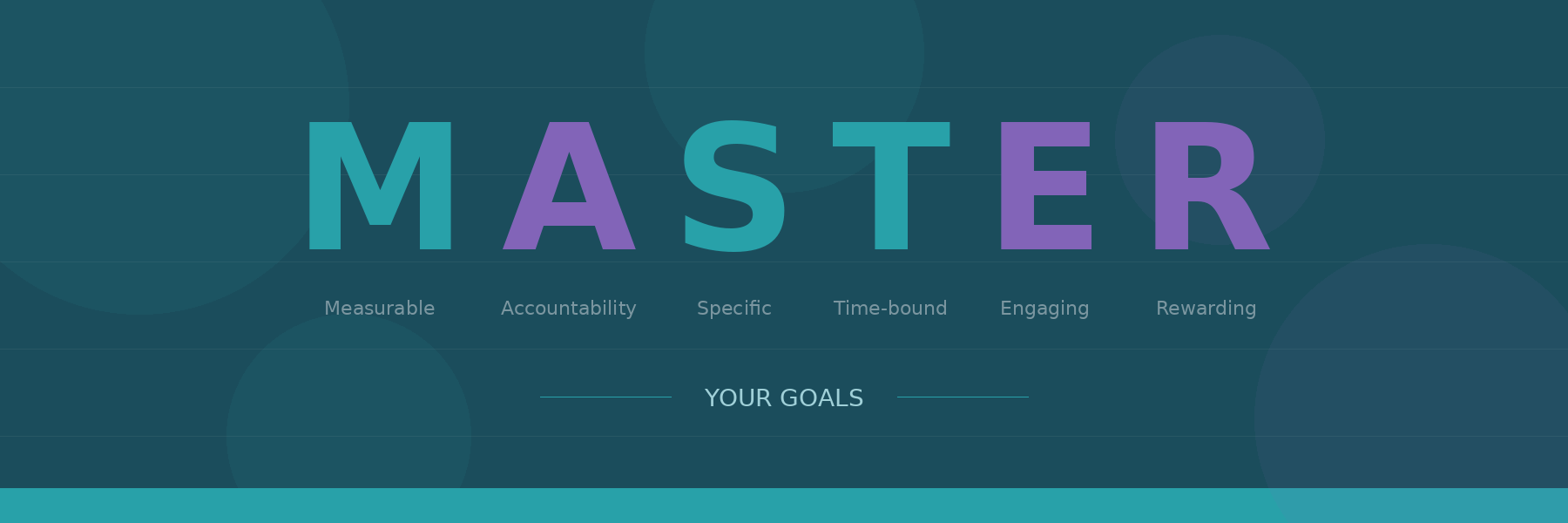
MASTER is a six-element goal-setting methodology designed specifically for ADHD brains. It keeps the structural clarity of SMART but adds what was missing - the elements that actually get us from intention to action.
Here’s what it stands for:
M - Measurable “How will I know it worked? What would I notice that is different?”
Notice the prompt doesn’t ask “how will I measure it?” - it asks what you’d notice. That’s deliberate. For ADHD brains, lived experience matters more than metrics. The question “what would be different?” gives you something concrete to look for, without turning your goal into a spreadsheet.
A - Accountability “Who will know about this goal? Who can I check in with?”
This is completely absent from SMART, and it’s one of the most important additions. ADHD brains struggle with self-monitoring - that’s not a character flaw, it’s executive function. An accountability partner, coach, or even a friend who asks “how’s that thing going?” provides the external structure your brain needs.
The prompt asks “how can I maximise my chances of success knowing how my brain works?” rather than “who will hold me accountable?” - because this is about support, not surveillance.
S - Specific “What exactly do I want to change? The more concrete the better.”
This one carries over from SMART, but it takes on extra importance for ADHD. Vague goals create decision paralysis. If your first step isn’t obvious, you won’t start. “Get healthier” is a wish. “Walk for 20 minutes on Monday, Wednesday, and Friday before work” is a goal you can actually begin.
T - Time-bound “By when? Make it small enough to achieve. If in doubt, make it smaller.”
Here’s where MASTER does something different. In SMART, “Achievable” and “Time-bound” are separate elements. In MASTER, they’re combined - because for ADHD brains, the answer to “is this achievable?” is almost always “yes, if you make it small enough.”
The repeated instruction - if in doubt, make it smaller - directly addresses our tendency to overcommit. We’re brilliant at imagining what we could do. We’re less brilliant at estimating how long it will actually take. So make it smaller. Then probably make it smaller again. A 10 minute task is not too small!
E - Engaging “Does this engage me? If not, how can I make it more interesting?”
This is the element that changes everything, and it’s completely missing from SMART.
ADHD brains have what Dr William Dodson calls an interest-based nervous system. We don’t do things because they’re important - we do things because they’re interesting, challenging, novel, or urgent. If your goal doesn’t engage you, it doesn’t matter how specific, measurable, or time-bound it is. It won’t happen.
But here’s the thing - engagement can be designed. The prompt asks “how can I make it more interesting?” because there’s almost always a way. Gamify it. Do it with someone. Change the environment. Add music. Make it a challenge. The goal stays the same; the approach becomes something your brain actually wants to do.
R - Rewarding “What’s the payoff? Build in a reward that makes the finish line worth crossing.”
This replaces “Relevant” from SMART, and the swap is deliberate. “Relevant” appeals to rational motivation: this matters, therefore I should do it. But ADHD brains don’t reliably convert rational understanding into action. We know it matters. We still can’t start.
Dopamine - the neurochemical of reward and motivation - is dysregulated in ADHD. So instead of asking “is this relevant?” (spoiler: you already know it is), MASTER asks you to build in an explicit reward. Something that makes the finish line worth crossing. Not as a bribe - as a design choice that works with your neurochemistry instead of against it.
Using MASTER in Practice
You don’t have to work through the elements in order. Start wherever feels natural - maybe you know the goal is specific but you haven’t thought about who’ll keep you accountable. Maybe you’ve got the reward sorted but the timeline is too ambitious.
The framework is a lens, not a checklist. Run your goal through it and see which elements are missing. That’s usually where it will fall apart.
Here’s a quick example:
Goal: I want to exercise more.
M - Measurable: I’ll know it’s working when I’ve done three sessions this week and I feel less restless in the evenings.
A - Accountability: I’ll text my mate Dan after each session.
S - Specific: 20-minute run on Monday, Wednesday, Friday before work.
T - Time-bound: This week. Just this week. I can decide about next week later.
E - Engaging: I’ll try a new podcast episode each time - I only listen to it while running.
R - Rewarding: Friday’s run ends at the good coffee shop.
Notice how different that feels from “I want to exercise more, and it’s relevant to my health.” Same goal. Completely different relationship with it.
Why “MASTER”?
The name is intentional. SMART implies cleverness - a cognitive quality. MASTER implies agency and ownership. For people who’ve spent years being told they lack discipline, focus, or follow-through, the invitation to master their goals reframes the whole relationship.
You’re not failing at SMART goals because you’re not smart enough. You’re failing at them because they weren’t built for your brain. MASTER your goals instead.
Try It This Week
Pick one goal. Just one. Run it through the six MASTER elements and write down your answers. Pay particular attention to the three that SMART misses - Accountability, Engaging, and Rewarding. Those are usually the ones that make the difference.
The MASTER Goals Framework™ was developed by Graham Carle as part of his ADHD coaching practice at shifted minds. © Graham Carle 2026. All rights reserved.
Graham is an AuDHD Coach and writes weekly about neurodivergence, coaching, and building a life that works with your brain rather than against it.